
Protocols for the Long Now
LAB 001.1 | Book of Time | Kachris-Newman
A Three-Engine Braided Sextant for Metabolic Dead Reckoning in Mixed-Substrate Civilizations
Civilization now operates across biological, digital, institutional, and planetary timescales simultaneously. Existing governance instruments measure isolated subsystems.
SELAH VOLTA is proposed as a navigational tri-braided instrument capable of measuring admissibility, cross-substrate drift, and long-term structural coherence.
SELAH VOLTA
SEE-lah VOHL-tah
the rest before the next turn
The Problem
Civilization-scale Navigation
Civilization has become highly skilled at measuring what it can do, but less capable of determining whether it should do it. Modern systems optimize local goals while losing sight of the larger conditions that sustain them, As biological, technological, ecological, and informational systems become increasingly entangled, a growing mismatch emerges between human decision-making timescales and the speed at which modern systems operate.
The result is a loss of positional awareness: we can navigate, but we increasingly struggle to determine whether our course remains admissible.
THE INSTRUMENT | THREE ENGINES
1. Ephemeris
Inherited reference structure.
The Ephemeris engine establishes a celestial fix. It situates the present moment within long-duration astronomical and calendrical cycles, providing a stable reference horizon against which all other readings are taken. Rather than measuring events, it measures position within inherited temporal structure.
2. Phase
Planetary medium-state.
The Phase engine measures the condition of the medium through which civilization moves. Climate, energy, ecology, resources, and biospheric dynamics form the substrate that enables or constrains action. It answers a simple question: what state is the planet currently in?
3. Armature
Technological and governance substrate.
The Armature engine measures the structures humanity has built around itself: institutions, infrastructure, markets, communication systems, computation, law, and collective coordination mechanisms. It tracks the condition of the civilizational framework through which decisions become action.
WHY NAVIGATION REQUIRES CONSTRAINT

Navigation is only possible when constraints exist.
A ship navigates because coastlines, currents, and stars constrain its movement. Remove the constraints and orientation disappears.The same is true for civilizations.
Every persistent system must solve three problems:
Persistence — remaining present through time.
Transport — moving energy, matter, information, or influence.
Closure — integrating outcomes back into the system so they can inform future action.
These three functions appear repeatedly across biological organisms, ecosystems, institutions, economies, and technological networks.
I / R / Sem
I — Indicative
Persistence, coupling, and sensation.
R — Relational
Availability, transformation, and interpretation.
Sem — Semantic
Signal, flux, and trace.
Together they form the minimum structure required for a system to maintain orientation while adapting to change.

Failure Modes
When persistence fails, systems lose continuity. When transport fails, systems lose coordination. When closure fails, systems lose learning. Collapse rarely begins with a lack of activity. More often, it begins with a loss of navigational fidelity between these three functions.
SELAH VOLTA treats navigation as the measurement of that fidelity.
The derivation of triadic necessity is developed in the companion documents linked below:
THE MAYA OPERATOR
Why the Maya?
SELAH VOLTA makes an original claim: calendric systems can function as instruments for civilizational metabolic dead reckoning. The Maya Long Count is the strongest test case because it links three scales in one architecture: biological renewal, governance review, and cumulative historical trace.
The argument is that the surviving calendric structure can be read operationally: as a system for maintaining orientation across biological, political, and astronomical time.
Gestation lands at 266.67 — the scanner is synced to the base 20 vegisemal scale of the Maya
The Anticipatory Scanner
The Maya Long Count offers substantial contributions to the inherited reference structure for Selah Volta.
Its base relation is simple: 1,872,000 = 260 × 7,200
The Long Count is the product of two clocks: the 260-day Tzolk’in and the 7,200-day K’atun.
Their ratio does not close cleanly: 7,200 ÷ 260 = 27 + 9/13
That remainder is important. The K’atun contains 27 gestational-scale intervals: 7,200 ÷ 27 = 266.67 days
But the Tzolk’in is shorter: 260 days. It arrives before the biological interval fully closes.
This makes it an anticipatory scanner, not a passive clock. SELAH VOLTA inherits that operating logic. It reads position by comparing cycles. It estimates drift between reference and medium. It dead-reckons when no single clock is sufficient.
The Maya operator is incorporated as navigational architecture with partial provenance (inscriptions and Dresden Codex).
Interactive 3x3 Meta Operator Grid
Click on any grid square to perform a fractal zoom and “decompose” the information based on the operator mechanics.
Fidelity: Marginal to good. Row 1 ±10yr. Row 2 ±20-50yr. Row 3 ±5yr.
Diagonal: Bronze Peak (I→I): floor at zenith. Dark Age (R→R): coupling with no floor. Iron Established (Sem→Sem): collapse records its outcome.
Diagonal: Iron Floor (I→I). Axial Peak (R→R): five simultaneous revolutions. Alexander (Sem→Sem): transformations record as permanent trace.
Diagonal: Imperial Floor (I→I): Qin. Incarnation (R→R): coupling transforms from within. Crisis (Sem→Sem): coupling era records its fractures.
Diagonal: Legalization (I→I). Pre-Islamic (R→R). First Renaissances (Sem→Sem).
Diagonal: Successor States (I→I). Translation (R→R). Schism & Closure (Sem→Sem).
Boundary: Maya Classic collapse (~900 CE) falls within sub-cell 1.
Diagonal: Printing Floor (I→I). Enlightenment (R→R). Digital (Sem→Sem): recording records recording.
Innermost cell (1949–2012): Shannon's information theory. ENIAC. ARPANET. Internet. The trace of the trace of the trace.
WHY THE LONG COUNT CANNOT BE REUSED
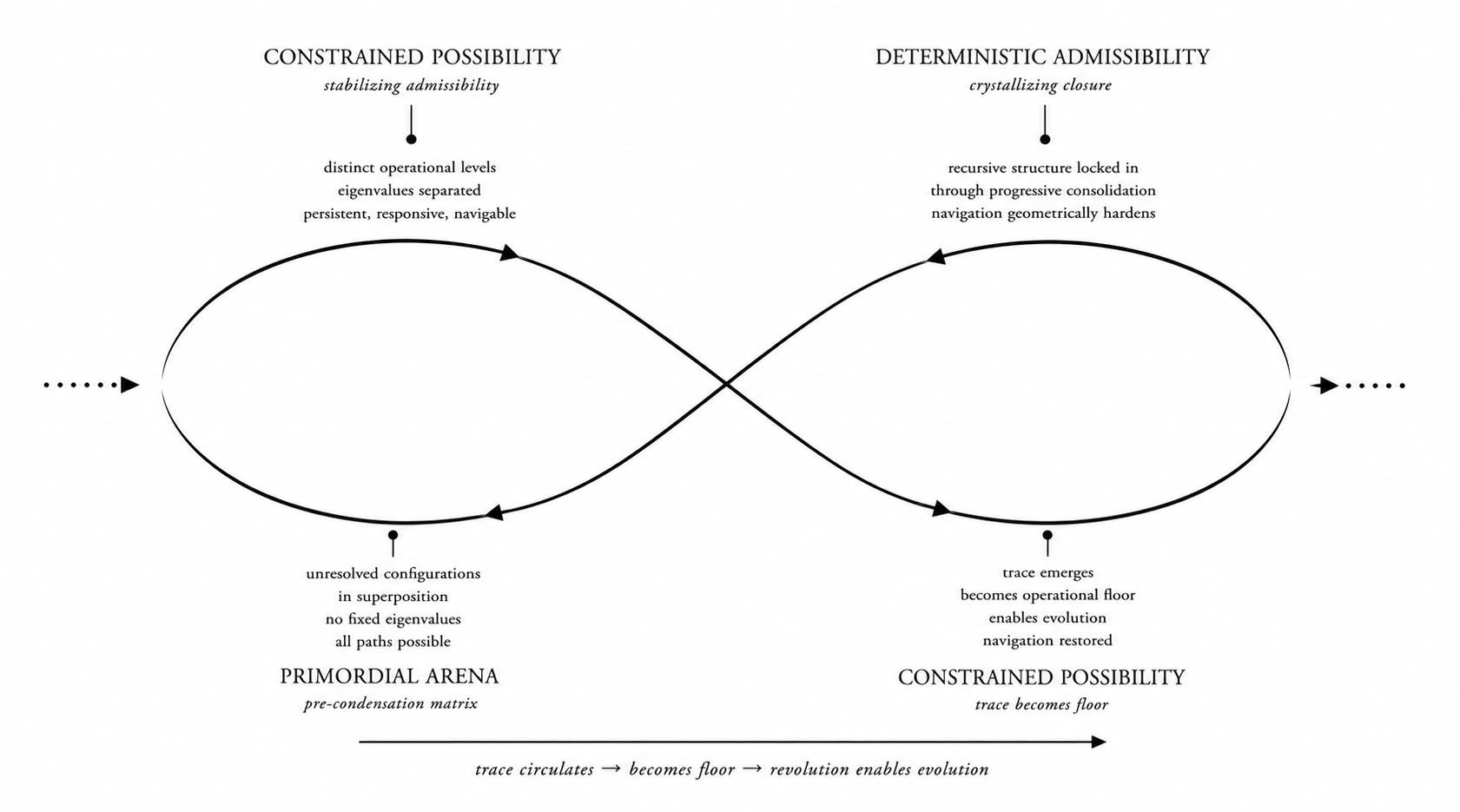
TRACE BECOMES FLOOR: The constrained floor humanity built — the entirety of civilization that was built from biological firsts, has ended.
On December 21 02012 — Global society’s relationship with Constrained Possibility was marked by the transition of ceiling (trace, accumulated technical knowledge) becoming the floor of the next regime: Deterministic Admissibility. The Long Count represents a 5,125 year long shared unit of our collective biological-to-technological metabolism — from the first wheel to AlexNet — and it has been digested.
The 13-bak’tun Long Count cycle reached 13.0.0.0.0 on December 21, 02012. The count can continue arithmetically; the claim here is this: the completed biological-governance instrument cannot simply be reused for a substrate whose replacement rate is no longer biological. Both inputs to the product equation — the scanner rate (Tzolk’in, gestation compressed by 1/40 for anticipatory monitoring) and the governance rate (K’atun, gestation lifted by 27 into civilizational time) — were tethered to biology. The operator that connects them, 27 + 9/13, is built from metabolic scaling and vigesimal body-count arithmetic. The principal timing constants are tied either to biological replacement, vigesimal body-count arithmetic, or naked-eye astronomical recurrence.
What follows is a regime in which the emergent technological substrate has no hard replacement rate, no generational succession, no metabolic pulse of its own. Contemporary AI systems do not have a biological replacement interval. Their tempo is governed by compute, data, capital, architecture, deployment cycles, and user feedback, not by gestation, maturation, or generational succession. You cannot compute a Long Count for a system that doesn’t gestate at a locked rate. The product equation has no second factor.
So the next instrument cannot be a pure clock.
It must contain a sextant — a device that takes an angle when you can get a sighting, logs the fix, and dead-reckons between sightings. The biological clock still runs. It becomes the Ephemeris engine: the stable reference. Phase reads the planetary medium. Armature reads the modern structural frame. The Ledger records the torsion across all three.
The Long Count completed. Its trace became the floor of the next regime. Selah Volta inherits that floor and navigates forward from it — not with one clock but with three braided engines reading reference, medium, and vessel simultaneously.
*The 3x3 operator grid exists independently; 02012 is being evaluated against the operator.
The challenge is to find any other sub-260 day period that fills all nine cells under the same grammar of persistent firsts.
THE PROTOTYPE
SELAH VOLTA is not a theoretical proposal alone. A prototype exists. The system ingests a trace, decomposes state into triadic channels, computes admissibility conditions, identifies refusal dynamics, and records all outputs to an auditable ledger. Several core components are operational:
READ mode
ACT mode
Fidelity gating
Refusal detection
Boundary-state tracking
Replayable audit traces
The prototype separates observation from recommendation. READ records evidence. ACT generates guarded responses derived from that evidence. A fidelity gate prevents ACT outputs from being produced when trace integrity falls below acceptable thresholds. Every state transition is recorded and can be replayed from source data.
A SELAH VOLTA reading is falsified when cross-engine divergence is reported as low and subsequent events reveal that substrate conditions had already moved outside range.
Operational Artifacts
The prototype includes:
executable source code
state traces
ledger outputs
These artifacts allow individual runs to be inspected, reproduced, and audited. Unlike many contemporary AI systems, the prototype is designed around traceability rather than opaque output generation.
Example Outputs
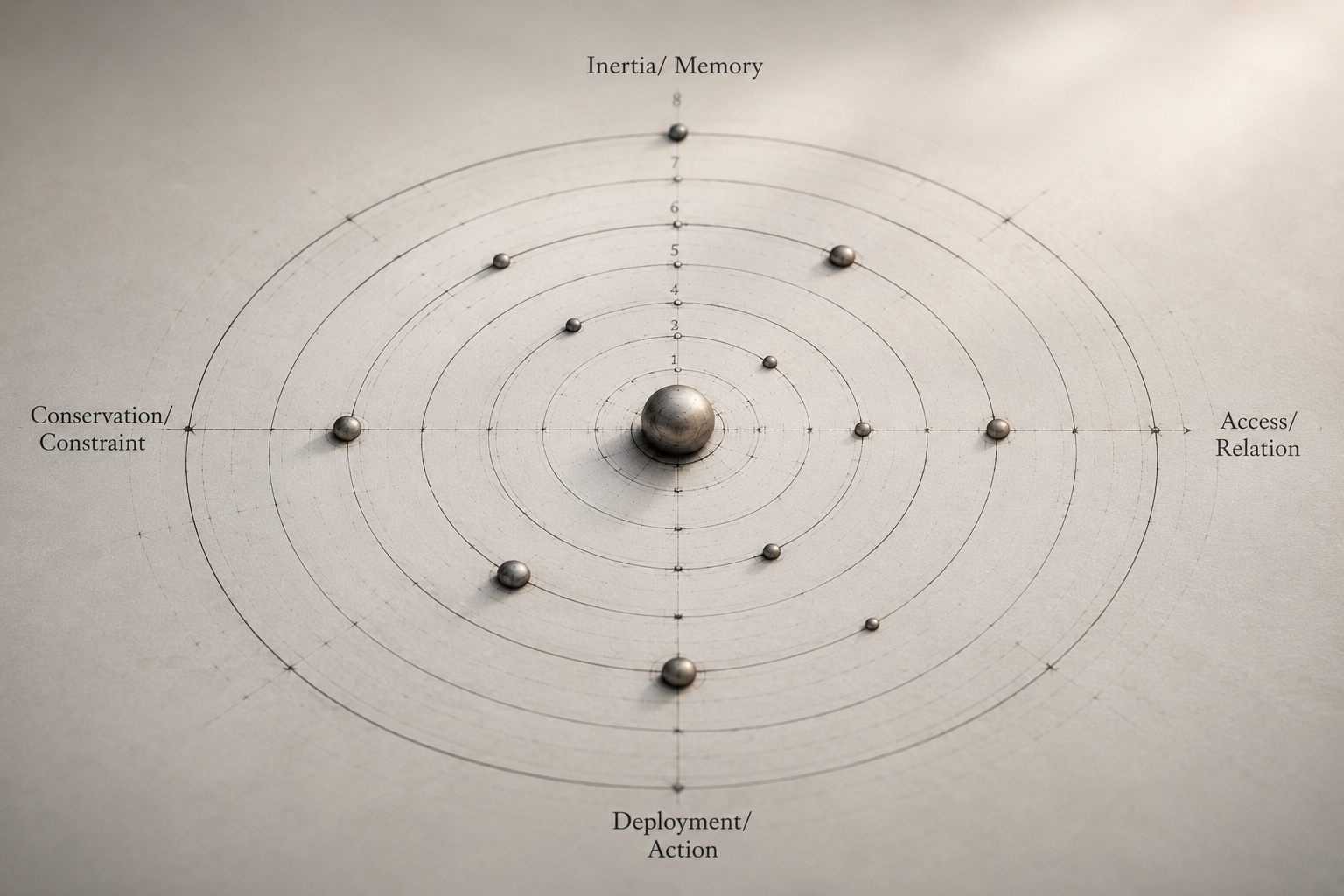
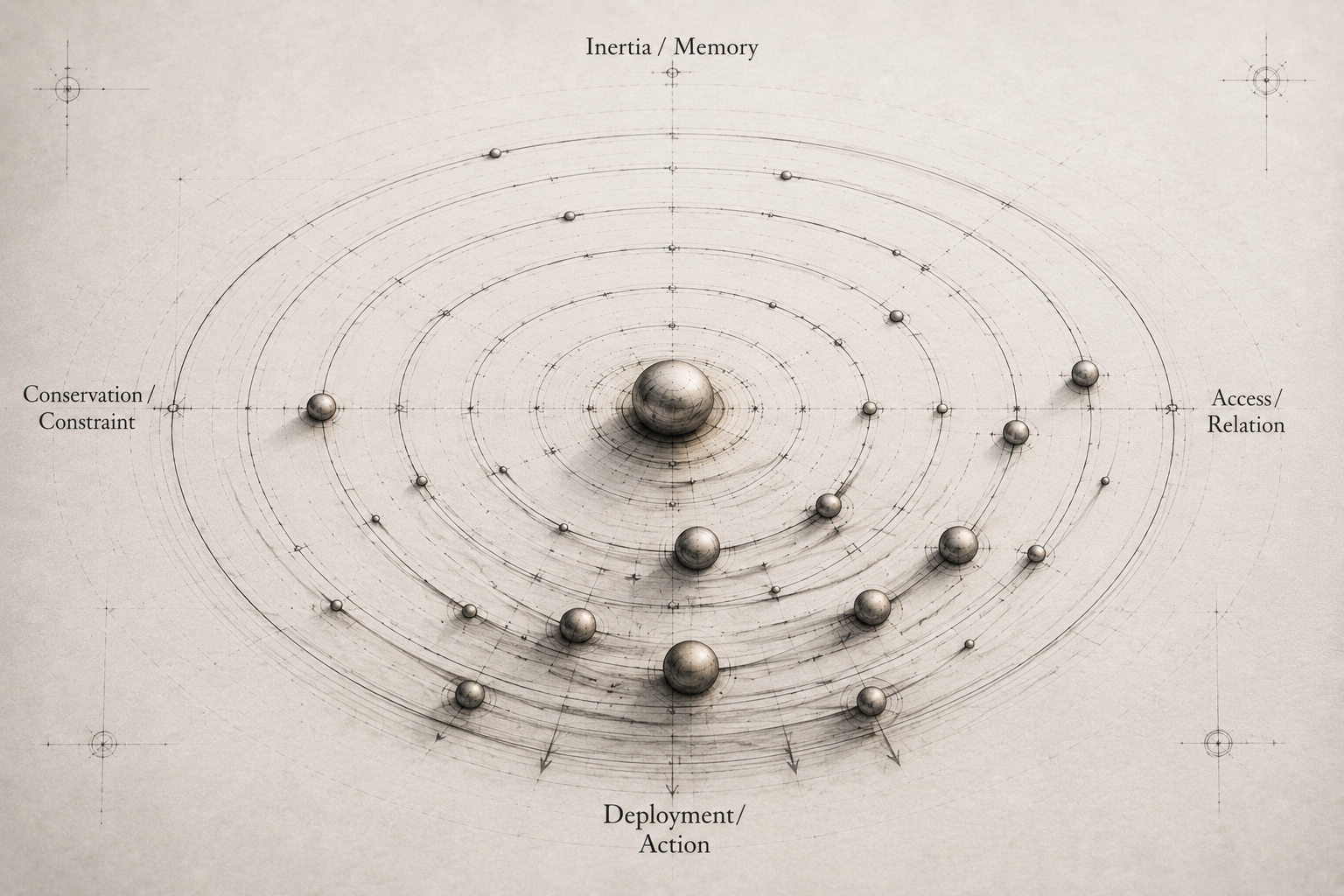
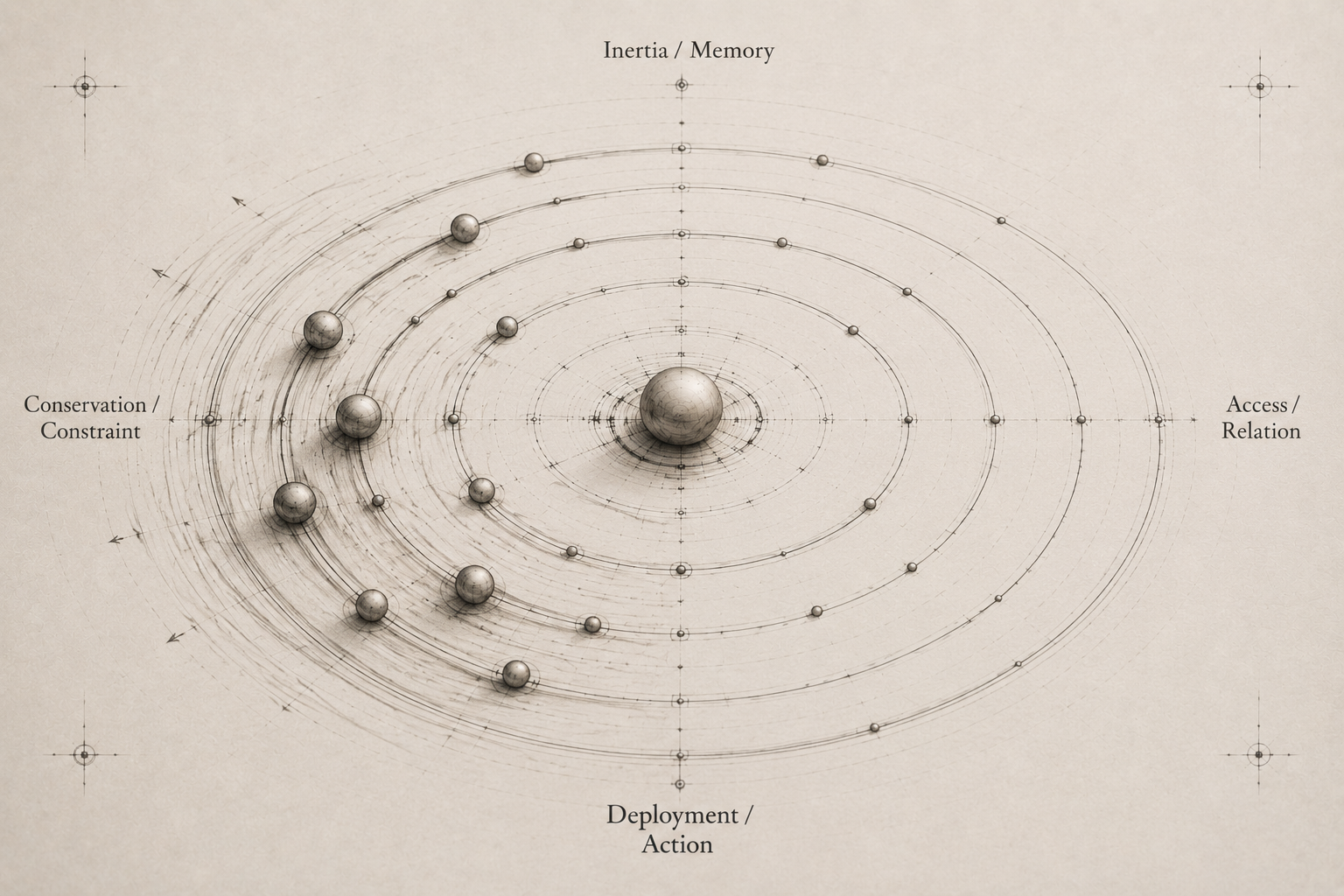
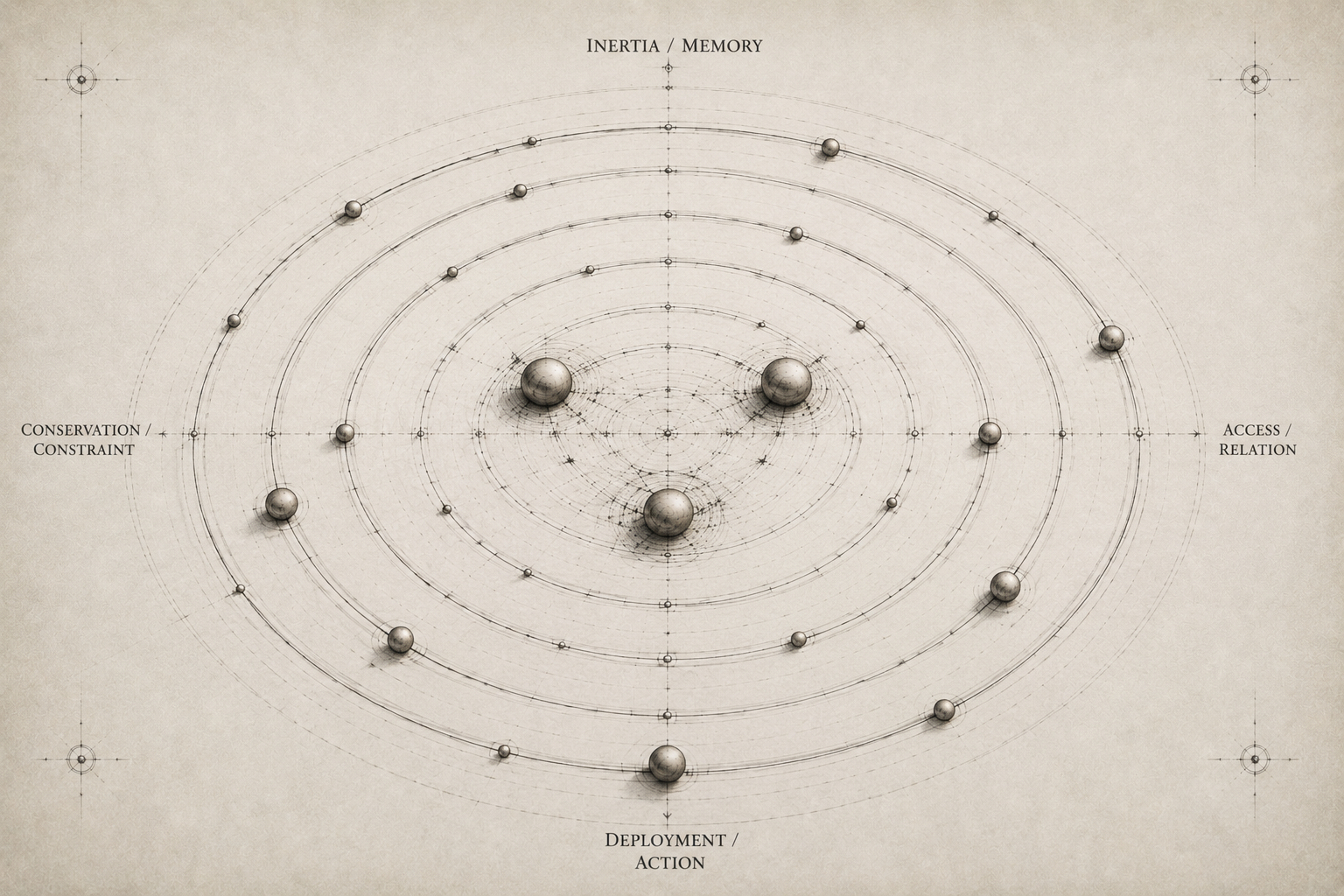
Representative outputs include:
admissibility trajectories
refusal events
boundary transitions
restoration sequences
fidelity measurements
audit ledgers
Each run produces a permanent record that can be reviewed independently of the resulting recommendation.
SEXTANT TO ORRERY
DIGITAL-TO-PHYSICAL REPRESENTATIONS
The Instrument and the Orrery
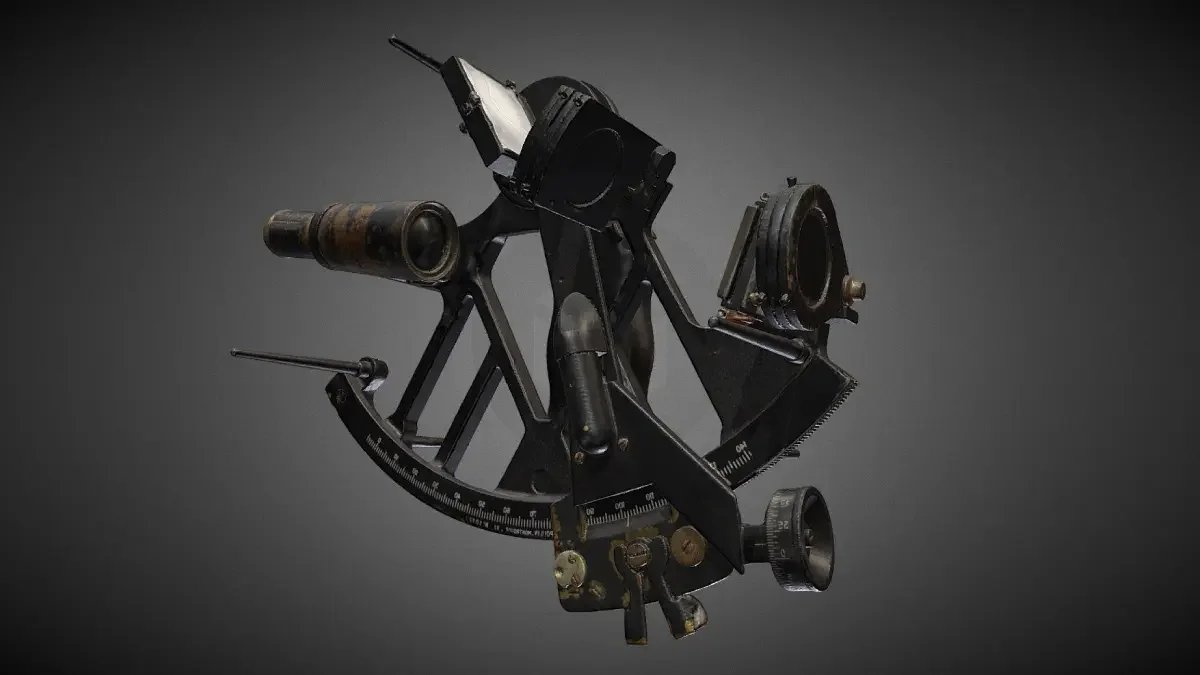
SELAH VOLTA exists first as a digital instrument.The interface functions as a sextant for reading position across multiple interacting constraints simultaneously. Signals enter through a larger field of observations, relationships, and traces, but the reading ultimately resolves downward into twenty-seven structural nodes. The purpose of the instrument is orientation. The question it answers is: where is the system relative to the constraints that govern its persistence?
Digital instruments are powerful because they can process large volumes of information quickly. Their weakness is equally obvious. The reading remains abstract. The user sees a position but does not inhabit it physically.
For that reason SELAH VOLTA is designed to admit a second form.
The 81 node 3-engine digital architecture can be summed back to a 27-node representation as a physical orrery.
Each node exists as a precision-cast component occupying a fixed position within the larger structure. The geometry preserves the same relationships visible in the digital instrument, but translates them into a manipulable object. A user can physically rotate the assembly, inspect its structure, remove individual nodes, and examine the configuration from multiple perspectives.
Every node contains a removable identifiers.
Unscrewing a node reveals a nest triad tagged insert carrying a unique identity. The identifier can be scanned by a companion application, linking the physical component to its digital counterpart. The physical and digital instruments therefore remain synchronized. A node is not merely a symbolic marker. It is a persistent address within the larger navigational architecture.
The result is an augmented-reality orrery.
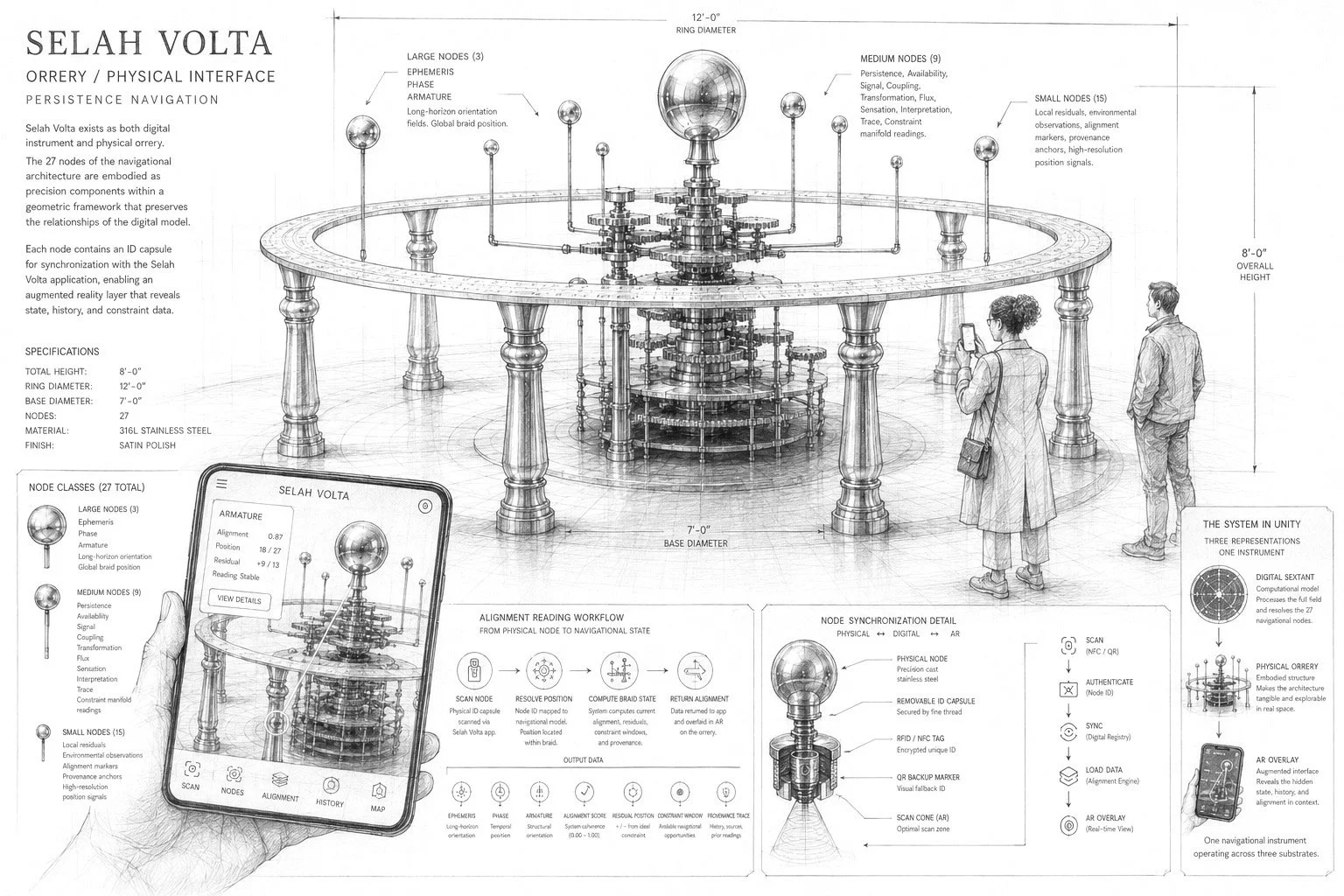
The digital sextant provides computational orientation. The physical instrument provides spatial orientation. The augmented layer allows information, provenance, historical readings, and active constraints to be projected back onto the object itself. The user can hold the structure, rotate it, inspect individual nodes, and view the accumulated trace associated with each component while maintaining access to the computational reading generated by the digital system.
Historically, navigational instruments often existed in both abstract and physical forms. Calendars were calculations but also monuments. Star positions were mathematical relationships but also arrangements of visible markers. The instrument was not separated from the object that embodied it.
The SELAH VOLTA orrery follows the same principle. The digital system calculates position. The physical system makes position tangible. Together they form a single navigational instrument operating across two substrates simultaneously: one computational, one material. The reading remains the same. Only the mode of orientation changes.
CONNECTION TO EXISTING LONG NOW PROJECTS
Dr. Nina Miolane
One area of overlap with existing Long Now work is the research of Dr. Nina Miolane on geometric representations of cognition and consciousness. The connection is not that SELAH VOLTA models consciousness, nor that the project advances a theory of mind. Rather, both efforts explore how complex, high-dimensional systems can be represented as navigable manifolds whose structure reveals relationships that are difficult to perceive in lower-dimensional views.
SELAH VOLTA’s manifold architecture emerged from the development of UTCP, Coalescence Gradient, and CG-M10.
The Coalescence Gradient arrives at the same fundamental geometric intuition about consciousness through a different lineage, and the engine itself has origins closer to the Coalescence Gradient manifold-centered approach. Within that work, the central challenge was not consciousness but operational navigation: how persistence, relation, interpretation, and trace interact across multiple timescales to produce admissible action. The resulting engine represents system state as a structured manifold in which convergence, divergence, stability, refusal, and reconciliation become geometric rather than purely symbolic properties.
The relationship is therefore architectural rather than substantive. SELAH VOLTA does not attempt to model minds. Instead, both projects investigate whether geometry can serve as a navigational language for systems whose essential behavior emerges from relationships, trajectories, and constraints rather than from individual components alone.
For The Long Now, the relevance is that both efforts are concerned with legibility across scales. Miolane’s work seeks geometric approaches to understanding cognition; SELAH VOLTA seeks geometric approaches to understanding long-horizon navigation, governance, and civilizational persistence. They occupy different problem domains, but they share a common interest in manifold-based representations as tools for making otherwise opaque systems more understandable and more navigable.
10,000-Year Clock
The 10,000-Year Clock converts deep time into a physical artifact that can be visited, heard, and touched. Selah Volta complements it: where the Clock makes time legible at civilizational scale, Selah Volta makes position legible at metabolic scale — the intermediate scale between a human heartbeat and a geological epoch, where governance actually operates.
CLOSING
A ship in open ocean without a sextant, without a celestial fix, and without a dead reckoning log is not free. It is lost. It cannot choose its heading because it doesn’t know its position. Every decision becomes drift.
Civilization in 02026 is that ship. The instruments we use to make the most consequential decisions — about AI governance, climate intervention, institutional reform — are optimized for speed, not fidelity; for production, not refusal; for now, not for trace. We are navigating a mixed-substrate world with single-substrate instruments that were obsolete before the substrate began to shift.
SELAH VOLTA is a proposal to build a navigational instrument designed for the substrate we actually occupy. It inherits its logic from the biological constants that still govern us, its discipline from the calendrical admissibility logic preserved in Maya daykeeping traditions, and its architecture from the mathematical constraints that govern every persistent system — from a lake to a cell to a civilization.
It does not predict. It navigates. It refuses when the fix is bad. It logs the track so the drift can be seen. And it is offered in the conviction that the Long Now’s most radical contribution may be not a clock but a sextant: a way to know where we are, so we can choose where to steer.
RELATED RESEARCH
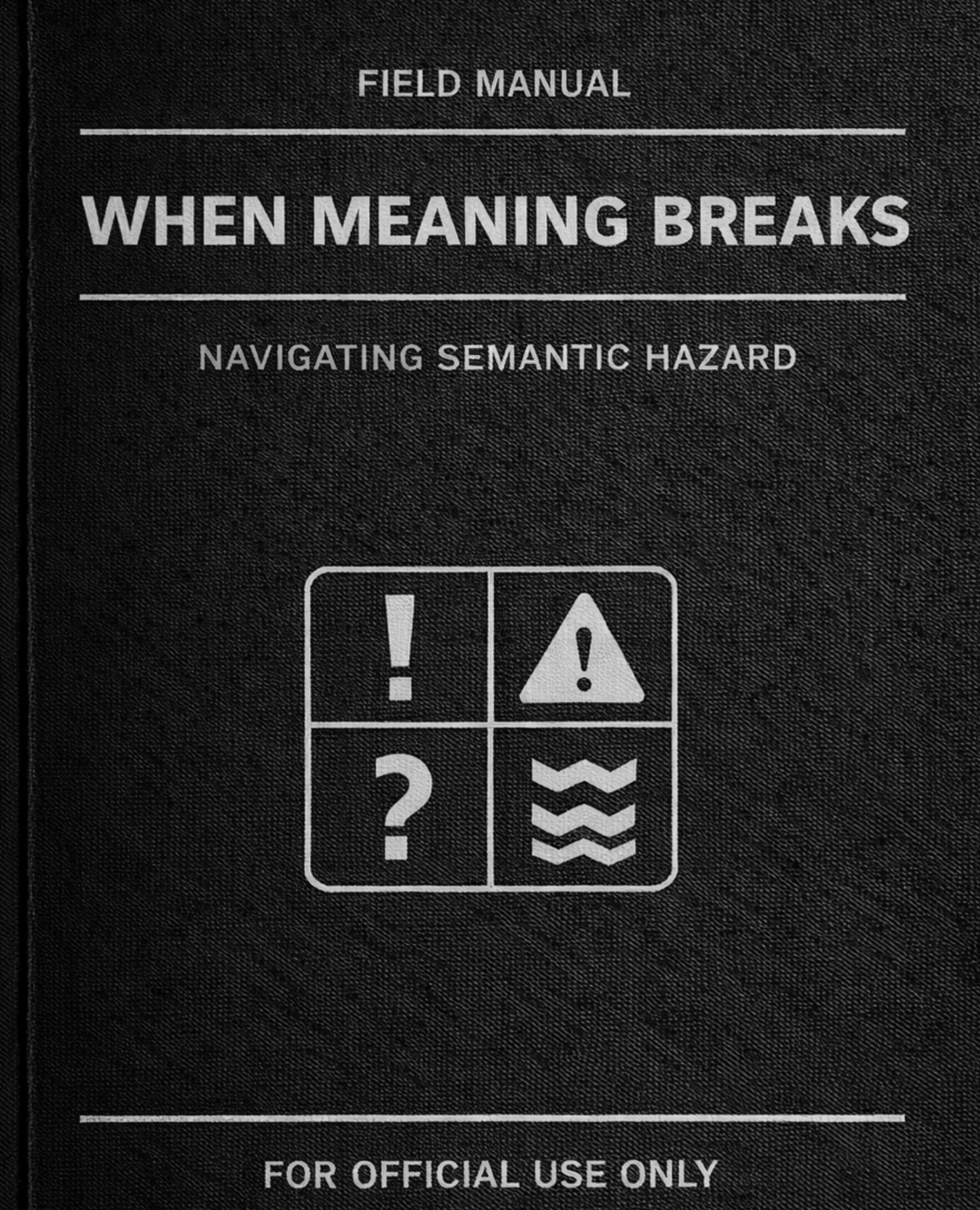
A phenomenology of institutional breakdown for people living in failing meaning systems. This triadic decomposition of historical governance, social, and technological meaning failure is provided as a structural observance and grammar — not resolution.
When Meaning Breaks an observational failure diagnostic language for the Phase + Armature engines.
A semantic governance framework that organizes and structures whether information is admissible for meaning formation, inheritance, and action.
PRISM provides a governance protocol for fused meaning under time pressure.
THE MATHEMATICAL FRONTIER
The prototype mathematics models admissibility geometrically through triadic decomposition, coupled transport structure, and closure boundaries.
The current algebraic framework draws on exceptional structures including J₃(O), E6, E7, and E8.
Further details:
Part I: Algebraic Foundations (Revision 5.5)
Part II: The Grammar of Navigational Debt
The algebraic structures here are supporting architecture, not prerequisites for the navigational argument above.
Submitted by: Kachris-Newman CG-M10 Research Program UTCP // May 02026